


Do you have questions about our features?
Would you like to learn more about our calculation functions, calculation outputs, or the Dendrit workflow? Then please contact us!


The purpose of a piping network calculation in accordance with DIN 1988-300 for the design of circulation systems is to design an ideal piping network that ensures optimal flow distribution. In the circulation system, this ensures that the hot water temperatures can be maintained above the required 55 °C with minimal energy consumption. The results of such a piping network calculation are used to determine an actual operating point on the pump characteristic curve as well as actual operating points for the control valves.
Even in new designs, the idealized operating points can only be approximated – both with the circulation pumps available on the market and with actual control technology. It therefore makes sense, even for new designs, to use a simulation to visualize the effects of these deviations on the expected operation of the circulation system, taking into account the actual hydraulic and thermal conditions.
When retrofitting circulation systems, simulating the interaction between the installed circulation pump and the actual piping network is essential for you. This provides a realistic representation of, among other things, the impact of new pump technology, piping network modifications, improvements to pipe insulation, and the ever-necessary retrofitting of control technology on the operation of the piping network.
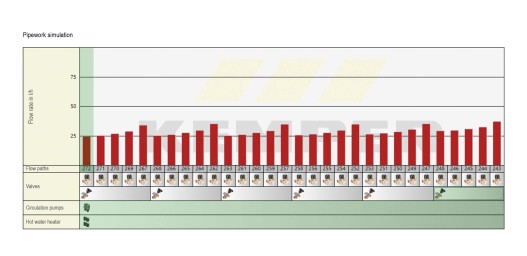
Download a sample document for hot water simulation.
The simulation of the flushing processes routinely implemented in a drinking water system provides you with all the necessary settings so that you can achieve the maximum effect in improving the hygiene-related conditions of the drinking water system using a minimal flushing volume.
To prevent water stagnation in cold-water drinking water systems during periods of low use, automatic water replacement and flushing measures are necessary – especially when the premises are unoccupied, such as on weekends or during vacation periods. Stagnant water absorbs ambient heat; when the temperature exceeds 25 °C, this can promote bacterial growth.
Unlike conventional systems, flow divider installations require only a few centrally located flush valves or stations. Centralized flushing systems enable time-, volume-, or temperature-controlled flushing of temperature-sensitive pipeline sections. In this process, a flushing operation is triggered at a specific time or when a temperature threshold is exceeded.
The flushing simulation supports both manual flushing and automatic flushing using the KEMPER KHS hygiene system.
In the simulated rinse cycle, you can also model a combination of systems. This allows you to combine end-of-cycle rinse units (hygienic rinse/C-valve technology) with cascaded rinses (A-B-valve technology).
Learn more in the video
For years now, the simulation of hot water circulation has been an integral part of drinking water distribution system design and planning. With Dendrit, you can also apply this approach – transitioning from standard-based calculations to those based on physical properties with corresponding results – to cold water circulation. Following the calculation, a simulation is performed, valve settings are determined, and pumps are adjusted to their actual operating point. The physical simulation is characterized by the simulation of thermal control and flushing valves, as well as the flushing simulation for calculating flushing times and volumes. This is a Dendrit standard that we have also developed for cold-water circulation.
The KEMPER KHS CoolFlow cold water cooler with an integrated pump and heat exchanger, as well as the KEMPER KHS CoolFlow cold water control valve with its three functions – shut-off, flushing, and thermal control – are also available in the simulation view.
The real-world physical simulation determines the temperature profile in the system and returns the necessary settings. The results of the simulation for the cold-water circulation are presented in the usual way in a separate simulation report, with numerous export formats available.
The calculation and simulation of GEBERIT in-line systems, loop circulation systems, and flow divider installations are also compelling reasons to use Dendrit CALHYDRA or Dendrit STUDIO for cold-water circulation planning.
The results of the cold-water circulation simulation are presented in the usual manner in a separate simulation report, with numerous export formats available.