Do you have questions about our features?
Would you like to learn more about our calculation functions, calculation outputs, or the Dendrit workflow? Then please contact us!


The KEMPER KTS Thermosystem is a drinking water heating system based on the flow-through principle. It combines the highest standards of drinking water hygiene, energy efficiency, comfort, and reliability of supply at all draw-off points. With the KTS design module in Dendrit STUDIO, you can use wizards to design the KEMPER KTS Thermosystem. To determine the specific demand scenarios, detailed data on water consumption and user profiles in medium-sized and large buildings have been analyzed and integrated as reference buildings. The profiles can be individually customized and combined to obtain a realistic representation of user behavior. In addition, it is possible to model special profiles, demand profiles according to DIN 4708, create demand profiles based on defined tapping operations, and define additional circulation flow rates.


With just the click of a button, Dendrit STUDIO generates detailed documentation for you, including relevant information on hydraulics and performance:
An export of the KTS hydraulic diagram in DWG format, along with the comprehensive results documentation, rounds out the presentation of results for you.
By entering tried-and-tested default values, the system generates a suggested result as soon as the requirements are defined. Of course, you can adjust the displayed results to reflect the specific circumstances of your project.
Kemper KTS in Dendrit STUDIO
Residential distribution stations – decentralized instantaneous hot water heaters – heat drinking water locally, in close proximity to the areas they serve. Therefore, in addition to the cold-water pipes, only the necessary heating pipes need to be routed to the stations. Within the individual supply zones, the pipe volume of a single flow path is usually less than 3 liters. Under these conditions, circulation lines throughout the entire building are also eliminated. Areas posing a risk to drinking water hygiene are minimized. Since the heating systems in these supply zones are classified as small-scale systems under standards, the hot water temperature may be set to a level below 60 °C.
The hydraulic balancing of the apartment distribution stations in the heating pipe network is performed automatically via an integrated differential pressure regulator. Decentralized drinking water heating thus not only saves costs and time during the construction phase but also ensures an energy-efficient heat supply during operation. Dendrit STUDIO offers apartment distribution stations with or without downstream living space heating and with or without a circulation connection.
With Dendrit STUDIO, you can hydraulically integrate all apartment distribution stations for both heating and drinking water systems and design them, including the selection of accessories. In addition, Dendrit STUDIO also takes into account priority circuits, which allow for alternating supply between drinking water heating and residential space heating, thereby resulting in a more streamlined piping network.
If the priority circuit is activated for domestic hot water heating, only the higher heat output for domestic hot water heating is taken into account when determining the total heat output. Since the heating mode is connected downstream, the lower heat output of the heating load is not included in the total heat output. The analysis of priority circuits thus completes the design of the decentralized domestic hot water heating system.
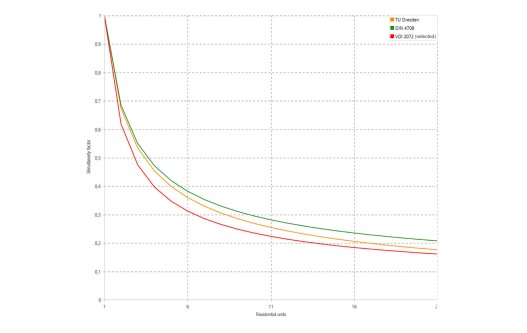
Since it cannot be assumed that all hot water outlets will be used simultaneously, Dendrit STUDIO takes concurrency factors into account in the heating system, making it easy to perform calculations with the highest possible accuracy. Dendrit STUDIO offers concurrency calculations based on DIN 4708, the Technical University of Dresden, and VDI 2072 as options in the design settings.